Romney Readiness Project by Campbell Clark & Kroese Daniel & Liddell Christopher
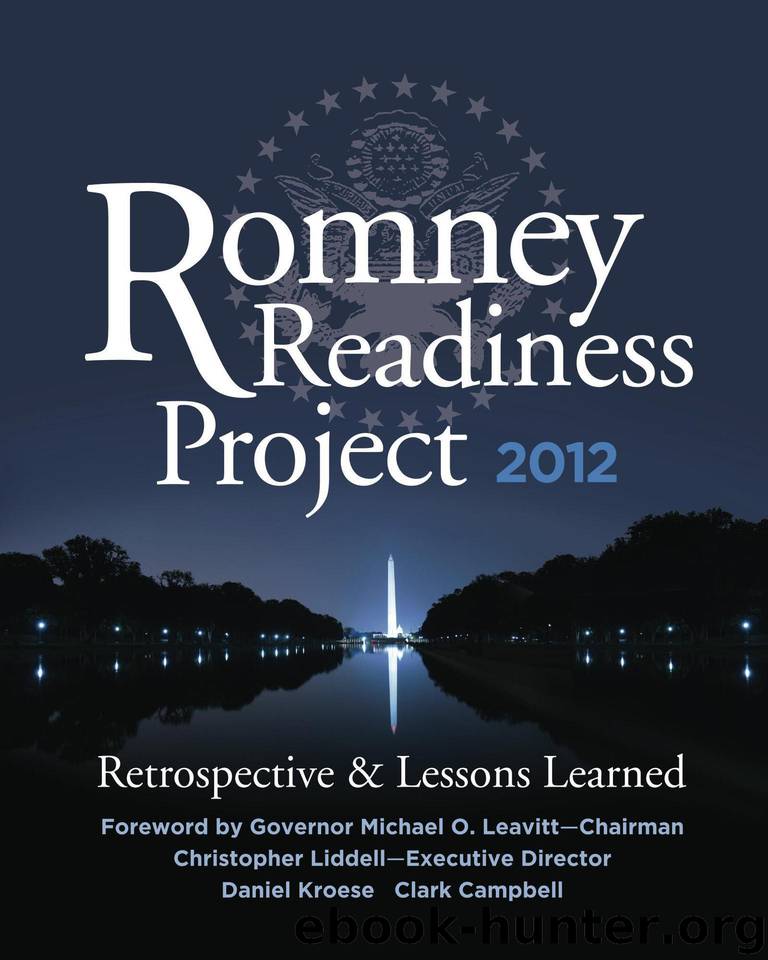
Author:Campbell, Clark & Kroese, Daniel & Liddell, Christopher [Campbell, Clark]
Language: eng
Format: epub
Publisher: Unknown
Published: 2013-06-24T16:00:00+00:00
Chapter 7
200 Day Plan
200 Day Plan
Presidential Appointments President-elect Support
Congressional Administration
Relationships Design
7.1 Overview
Presidents often enjoy greatest influence early in their terms. Since 1933, when President Franklin D. Roosevelt passed 15 major bills through Congress in the 105 days following his Inauguration, the media and public have emphasized the importance of early actions taken by new presidents. Similarly, the Readiness Project was tasked to ensure that a potential Romney administration would be prepared to implement its agenda as early and effectively as possible.
To facilitate this, a Final Deliverable was created to: Prepare a 200 Day Plan for the new administration.
There are several critical components of this objective. The first is the 200-day period. The first 100 days is often referenced as a benchmark to evaluate early success of an administration. Two hundred days was instead chosen as the appropriate time frame because it was short enough to force a tight set of actions, but long enough to provide ample runway for execution.
Secondly, it is important that the promises and commitments belonged to the Campaign . Governor Romney and his policy team had complete ownership over the makeup of his Campaign commitments. The Readiness Project had no role determining these commitments, and was simply focused on post-Election implementation.
Reinforcing this distinction required discipline and ongoing coordination. As a forcing mechanism, Governor Romney’s Campaign promises and commitments were distilled into a document titled ‘General Instructions – First 200 Days.’ (See Appendix 7.1) The document was the product of extensive collaboration with the Campaign’s Policy Director, Lanhee Chen.
Since the General Instructions would be circulated broadly among the 250 members of all the Department and Agency Review Teams, language was consciously adopted that closely mirrored Campaign literature to ensure it would be consistent with policy announcements that had been made publicly available. Within those parameters, the final document generally struck an appropriate balance between guiding the Review Teams and the Task Forces, while also granting them sufficient flexibility to recommend innovative solutions to the issues facing the country.
In looking at the 200 Day Plan, the concept of “narrow and deep” was emphasized – i.e., focus on a relatively small set of commitments and ensure there were plans to achieve them to a very high standard. While recommendations for all campaign promises were leveraged, it was intended that only a narrow subset would be the focus of the first 200 days.
200 Day Plan
Presidential Appointments
President-elect Support
Congressional Administration Relationships Design
7.2 Organization Design and Leadership
The creation of the 200 Day Plan involved two different groups at the Readiness Project – the Department and Agency Review Group led by Jim Quigley and the Policy and Strategy Council led by Tim Adams. Both men brought great expertise and perspective to their roles. Quigley had just retired as the CEO of Deloitte, a professional services firm with over 180,000 employees. This executive experience suited him well to lead the Department and Agency Review Group, which while comparatively small to Deloitte, was the largest at the Readiness Project. Adams has significant policy experience in Washington
Download
This site does not store any files on its server. We only index and link to content provided by other sites. Please contact the content providers to delete copyright contents if any and email us, we'll remove relevant links or contents immediately.
| Anthropology | Archaeology |
| Philosophy | Politics & Government |
| Social Sciences | Sociology |
| Women's Studies |
The Secret History by Donna Tartt(19475)
The Social Justice Warrior Handbook by Lisa De Pasquale(12296)
Thirteen Reasons Why by Jay Asher(9126)
This Is How You Lose Her by Junot Diaz(7058)
Weapons of Math Destruction by Cathy O'Neil(6470)
Zero to One by Peter Thiel(5953)
Beartown by Fredrik Backman(5946)
The Myth of the Strong Leader by Archie Brown(5630)
The Fire Next Time by James Baldwin(5592)
How Democracies Die by Steven Levitsky & Daniel Ziblatt(5333)
Promise Me, Dad by Joe Biden(5230)
Stone's Rules by Roger Stone(5195)
A Higher Loyalty: Truth, Lies, and Leadership by James Comey(5091)
100 Deadly Skills by Clint Emerson(5026)
Rise and Kill First by Ronen Bergman(4906)
Secrecy World by Jake Bernstein(4890)
The David Icke Guide to the Global Conspiracy (and how to end it) by David Icke(4854)
The Doomsday Machine by Daniel Ellsberg(4627)
The Farm by Tom Rob Smith(4614)
